
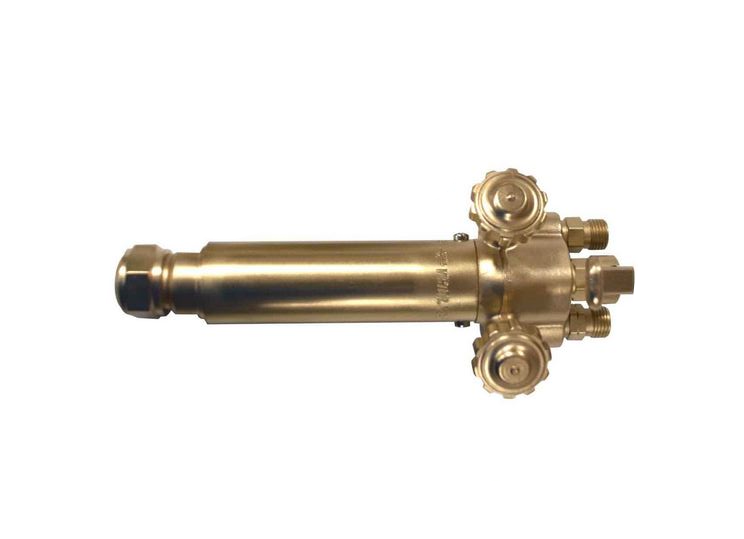
Victor MT204A Barrel Torch
- Victor Brand MT204A Short Barrel Torch is designed for mechanized cutting up to 7″ with a straight through design that minimizes turbulence and improves cutting performance. High performance mixer design provides optimum performance and a rugged brass torch head and body for maximum strength.
- Pre-Drilled 1.38″ (35.1 mm) Diameter Barrels for three position mounting flexibility
- Two Hose Design
- 8.5″ Overall Length
- 4.5″ Barrel Length
- Uses Victor style series 1 cutting tips (does not include tip)
- For use on Acetylene (may also be used on other pressurized fuel gases)
- Does not include rack
- P/N 0380-0215
$550.00
From Novice to Pro: Making the Right Choice for Your Cutting Needs
When I first stepped into my workshop as a professional metalworker fifteen years ago, I had no idea how much my choice of tools would impact my craft, efficiency, and even safety. Among all the equipment I’ve purchased over the years, my Victor Barrel Torch has become something of a trusted companion. Today, I’m sharing everything I’ve learned about these remarkable tools to help you make an informed decision.
After countless projects and thousands of cuts later, I can confidently say that choosing the right Victor Barrel Torch can make the difference between frustration and flow in your metalworking projects.
What Exactly Is a Victor Barrel Torch?
The first time someone handed me a Victor Barrel Torch, I remember being struck by its substantial feel and distinctive design. Unlike standard cutting torches, the barrel torch has a cylindrical body (hence the name “barrel”) that houses the mixing chamber where oxygen and fuel gas combine.
Victor Barrel Torches are premium oxy-fuel cutting tools manufactured by Victor Technologies, a company with over 100 years of history in the welding and cutting industry. They’re specifically designed for precision cutting of metals, particularly steel, with exceptional control and stability.
What sets them apart from standard cutting torches is their robust, barrel-shaped design. This isn’t just an aesthetic choice – the barrel construction serves important functional purposes that I’ve come to appreciate over years of use.
The barrel shape provides excellent balance and weight distribution, which significantly reduces hand fatigue during long cutting sessions. I once spent nearly six hours straight cutting through thick steel plates for a structural project, and the ergonomic design of my Victor Barrel Torch made that possible without the usual wrist and hand pain.
Why Would You Need a Victor Barrel Torch?
I’ve used my Victor Barrel Torch for everything from delicate sheet metal work to cutting through 8-inch thick steel plates. The versatility alone makes it worth the investment, but let me break down some specific applications:
- Heavy-duty steel cutting: When I was contracted to dismantle an old industrial boiler, the 6-inch thick steel walls would have been nearly impossible to cut through efficiently without my barrel torch.
- Demolition work: I’ve used my Victor to cut through structural beams and reinforcements when helping renovate an old warehouse into loft apartments.
- Fabrication projects: The precision of the barrel torch allows for clean, accurate cuts when creating custom metal pieces.
- Scrap metal processing: When I’m breaking down larger metal pieces for recycling or reuse, the barrel torch makes quick work of even the thickest materials.
- Construction and repair: From fixing farm equipment to constructing steel frameworks, the torch is indispensable.
I remember one particularly challenging job involving an old bridge girder that had been salvaged for an art installation. The steel was weathered, uneven, and nearly 5 inches thick in some sections. My standard cutting torch struggled, but when I switched to my Victor Barrel Torch, the difference was immediate. The cuts were cleaner, faster, and required significantly less effort.
How Does the Victor Barrel Torch Differ from Other Victor Torches?
Victor manufactures several cutting torch varieties, and understanding the differences helped me choose the right one for my shop.
The standard Victor cutting torch has a traditional design with separate tubes for gas and oxygen that join at the head. It’s lighter and good for general-purpose cutting, but it doesn’t offer the same stability or capability for heavy-duty work.
The journeyman series is a step up, offering better balance and more durable construction, but still falls short of the barrel torch’s capabilities.
Then there’s the Victor Barrel Torch – the heavyweight champion in their lineup. The key differences I’ve noticed include:
- Superior mixing capability: The barrel design allows for better gas mixing, resulting in a more efficient flame and cleaner cuts.
- Enhanced durability: My first barrel torch lasted nearly eight years of heavy use before needing any significant maintenance.
- Better heat management: The barrel design dissipates heat more effectively, preventing overheating during extended use.
- Improved balance: The weight distribution makes it easier to make precise cuts, even in awkward positions.
- Higher capacity: Barrel torches can handle thicker materials than standard torches.
I once had both a standard Victor torch and a barrel torch in my shop. During a rush job involving 3-inch plate steel, I let my apprentice use the barrel torch while I used the standard model. The difference was stark – he finished his cuts in about half the time it took me, with noticeably cleaner edges.
Key Features of the Victor Barrel Torch
After using various models over the years, I’ve identified the features that truly matter in a quality barrel torch:
Balanced Design
The ergonomics of the Victor Barrel Torch deserve special mention. During a major project last year that required cutting through hundreds of feet of steel plate, I noticed significantly less hand fatigue compared to when I used to work with standard torches. The weight distribution is masterfully engineered to rest naturally in your hand.
Multiple Tip Options
One feature I’ve grown to appreciate is the compatibility with various cutting tips. Depending on the model, Victor Barrel Torches can accommodate a range of tip sizes for different material thicknesses. I keep at least six different tips in my workshop for various applications, from delicate 1/8-inch sheet metal work to massive 8-inch structural plates.
Precision Gas Mixing
The internal mixing chamber is what gives the barrel torch its exceptional cutting performance. The gases mix thoroughly before ignition, creating a more efficient and powerful flame. I’ve noticed this results in cleaner cuts with less slag and fewer secondary passes needed to clean up edges.
Durable Construction
My current Victor Barrel Torch has survived being dropped from scaffolding, knocked off workbenches, and even briefly caught under a falling steel plate (that was a tense moment!). The solid brass construction with reinforced connections stands up to the harsh conditions of industrial environments.
Heat Resistance
During one particularly intensive project involving thick steel plates, I had to cut continuously for nearly three hours. My old standard torch would have overheated, but the barrel design efficiently dissipated heat, allowing me to complete the job without interruption.
Gas Control Valves
The precision valves on Victor Barrel Torches give exceptional control over flame characteristics. I can fine-tune the flame from a razor-sharp cutting jet to a broader heating flame with minimal adjustment. This level of control is crucial when working with varying material thicknesses.
Price Considerations for Victor Barrel Torches
Let’s talk about the elephant in the room – Victor Barrel Torches aren’t cheap. When I purchased my first one, I experienced serious sticker shock. However, after years of use, I’ve come to see it as one of the best investments I’ve made in my workshop.
Entry-level Victor Barrel Torch models typically start around $300-400, while premium models with additional features can range from $500 to $700. Then there are the professional-grade models that can exceed $1,000 with all accessories included.
I started with a mid-range model priced at about $550, which included the torch handle, cutting attachment, and a set of basic tips. Over time, I added specialized tips and accessories that probably totaled another $300.
Is it worth it? From my experience, absolutely. When I consider that my first barrel torch lasted over eight years of daily professional use, the cost per project was minimal. Additionally, the efficiency gained paid for the tool many times over in saved time and gas.
I remember calculating the difference once after switching from a budget torch to my Victor Barrel Torch. On a major project cutting 4-inch plate steel, I estimated that I saved about 30% on acetylene and oxygen consumption while finishing the job about 40% faster. For professional metalworkers, the math makes sense.
Where to Purchase a Quality Victor Barrel Torch
Finding a genuine Victor Barrel Torch requires some care – there are unfortunately knockoffs in the market that don’t deliver the same performance or safety.
I’ve purchased my equipment from several sources over the years:
Authorized Victor Dealers
My first barrel torch came from an authorized welding supply store in my city. The advantage was getting hands-on time with the torch before purchasing and receiving expert advice from the staff. They also offered a local warranty service that proved invaluable when I needed a valve replacement years later.
Industrial Supply Companies
Companies like Airgas, Praxair, and Northern Tool carry authentic Victor products. I’ve ordered replacement parts and accessories through these channels with good results.
Online Retailers
While I generally prefer seeing tools in person before purchasing, established online retailers like Baker’s Gas & Welding Supplies and Cyberweld have proven reliable for my colleagues. Just be cautious with marketplace sellers – always verify authenticity.
Secondhand Options
I found my backup barrel torch at an industrial auction for about half the retail price. It needed some cleaning and a new tip, but has performed flawlessly. Estate sales, closing businesses, and equipment auctions can yield great deals if you know what to look for.
When I purchased my current torch, I called three different suppliers to compare not just price, but also what was included in the package and the warranty terms. This extra research saved me about $80 and got me two additional cutting tips that weren’t included in competitors’ packages.
Suitability for Heavy-Duty Cutting
If you’re wondering whether the Victor Barrel Torch can handle serious industrial cutting tasks, my experience gives a resounding yes. The Victor Barrel Torch is specifically designed for heavy-duty cutting applications where standard torches simply can’t perform.
Last year, I was contracted to help dismantle an old steel bridge. Some of the structural members were 6 inches thick and had decades of paint, rust, and weathering. My Victor Barrel Torch cut through these challenging materials when other cutting methods failed.
The key advantage for heavy-duty cutting comes from the barrel design’s superior gas mixing and flow characteristics. This creates a hotter, more focused flame capable of slicing through thick materials with surprising ease.
I’ve successfully used my barrel torch on:
- 8-inch thick steel plate
- Multiple layers of hardened steel
- Cast iron components up to 4 inches thick
- Heavy I-beams and structural components
- Weathered and contaminated metals that other torches struggled with
One memorable project involved cutting through a massive 7-inch thick steel casting that had been part of an old paper mill. We initially tried plasma cutting, which barely scratched the surface. When I brought in my Victor Barrel Torch with the appropriate tip, we were able to complete the cut in a single pass, albeit slowly and with careful preheat.
Compatible Gases for Victor Barrel Torches
The versatility of Victor Barrel Torches extends to the fuel gases they can utilize. While I primarily use acetylene, these torches can be configured to work with several fuel gas options:
Acetylene
This remains my go-to gas for most cutting operations. It provides the hottest flame and best cutting performance, especially on thicker materials. My Victor Barrel Torch with acetylene can cut through 6-inch plate steel with impressive effectiveness.
Propane
I’ve occasionally used propane when acetylene wasn’t available or for outdoor work in windy conditions. It’s more economical but doesn’t achieve the same cutting speeds on very thick materials. For steel under 2 inches, however, I’ve found propane perfectly adequate.
Natural Gas
Some industrial settings use natural gas with specialized tips. While I haven’t personally used this configuration extensively, colleagues report satisfactory results for lighter cutting tasks.
MAPP Gas
MAPP (and MAPP substitutes) offer a middle ground between acetylene and propane. I’ve used this combination for field work where acetylene cylinders weren’t practical to transport.
It’s worth noting that you’ll need the appropriate cutting tips for each gas type. I learned this the hard way when I tried using a standard acetylene tip with propane and experienced poor cutting performance and excessive tip heating.
The Victor Barrel Torch’s adaptability to different gases has saved me in several situations, like when I was on a remote job site and ran out of acetylene. I was able to switch to a locally available propane tank with the appropriate tip and continue working with minimal downtime.
Setting Up Your Victor Barrel Torch
Proper setup is crucial for both performance and safety. I follow these steps every time I prepare my Victor Barrel Torch for use:
- Inspection: Before connecting anything, I carefully inspect all components for damage, debris, or wear. I once found a tiny metal shaving in a connection that could have caused a dangerous gas leak.
- Regulator installation: I attach oxygen and fuel gas regulators to their respective cylinders, ensuring the connections are clean and tight.
- Pressure settings: I set my acetylene regulator to 5-7 PSI and my oxygen regulator between 25-40 PSI, depending on the tip size and material thickness.
- Hose connection: I connect the color-coded hoses to the regulators and torch, checking for any signs of wear or damage along the entire length.
- Leak testing: Using a solution of soapy water, I check all connections for bubbles that would indicate leaks. This simple test has saved me from potentially dangerous situations multiple times.
- Tip selection: I choose the appropriate tip size for the material I’m cutting. For example, I use a #1 tip for thin sheet metal and might select a #6 tip for thick structural steel.
- Purging the lines: Before lighting, I briefly open each valve individually to clear any air from the lines, ensuring a clean gas flow.
- Lighting and adjustment: I open the fuel gas valve first, light the torch, then adjust for a neutral flame before opening the oxygen cutting lever.
I’ve developed this routine over years of professional use, and it’s become second nature. When I taught my apprentice this sequence, I emphasized that rushing the setup process is where many accidents and equipment failures originate.
Cutting Thickness Capabilities
One of the most impressive aspects of the Victor Barrel Torch is its cutting range. In my experience, these torches handle everything from thin sheet metal to remarkably thick steel plate.
With the appropriate tips, here’s what I’ve achieved with my Victor Barrel Torch:
- Thin materials (1/8″ – 1/4″): Clean, precise cuts with minimal kerf width using small tip sizes.
- Medium thickness (1/2″ – 2″): Smooth, consistent cutting with standard tips at moderate oxygen pressures.
- Heavy plate (3″ – 6″): With proper preheating and larger tips, the barrel torch cuts effectively where other torches struggle.
- Extreme thickness (6″ – 12″): While slow, I’ve successfully cut through 8-inch plate steel by using the largest tips, proper preheating, and patience.
I remember one particularly challenging job involving a 7.5-inch thick steel component from a decommissioned press. Many cutting methods had failed, but with my Victor Barrel Torch, proper preheating, and the correct tip, I was able to make the cut successfully, albeit taking nearly 45 minutes for a cut that was only 18 inches long.
The key factors affecting cutting thickness capability include:
- Tip size selection
- Oxygen pressure settings
- Preheat time and temperature
- Cutting speed
- Material composition and condition
I always keep a range of tips available, from size #00 for delicate work up to size #6 for the thickest materials. This versatility is one of the reasons I recommend the Victor Barrel Torch for shops that handle varying material thicknesses.
Warranty Coverage
When investing in professional equipment, warranty coverage matters. Victor typically offers a one-year warranty on manufacturing defects for their barrel torches, though this can vary by model and where you purchase.
My experience with Victor’s warranty service has been positive. About four years ago, the oxygen valve on my torch developed a leak that couldn’t be repaired with a simple O-ring replacement. Since it was still under warranty, my local dealer sent it to Victor, and I received a replacement part within two weeks.
For those considering a purchase, I recommend:
- Buying from authorized dealers to ensure warranty coverage
- Keeping your purchase receipt and warranty card
- Registering your product if the option is available
- Documenting any issues with photos if warranty service is needed
One important note: most warranties don’t cover normal wear and tear or damage from improper use. When my apprentice accidentally dropped my torch from a scaffolding onto concrete, the resulting damage wasn’t covered – a $175 lesson in proper tool handling.
Some distributors offer extended warranty options for an additional fee. I typically don’t purchase these since the Victor tools are so well-built that major failures beyond the standard warranty period are uncommon in my experience.
Maintenance and Cleaning Best Practices
Proper maintenance has extended the life of my Victor Barrel Torch significantly. Here’s my routine for keeping it in peak condition:
Daily Maintenance
After each use, I:
- Wipe down the exterior with a clean cloth to remove any debris or spatter
- Check and clean the tip orifices using the appropriate cleaning needles
- Inspect hoses for any signs of wear, damage, or burns
- Store the torch in a clean, dry area away from oils and greases
Weekly Maintenance
Once a week, I perform a more thorough check:
- Remove and clean the cutting tip with appropriate tip cleaners
- Check all O-rings and seals for wear
- Inspect all valve stems for smooth operation
- Test all connections for leaks using soapy water
- Clean the torch head with a brass brush to remove any accumulated slag
Monthly Maintenance
For deeper maintenance:
- Disassemble the head assembly and check internal components
- Clean the mixing chamber with compressed air (never use oxygen!)
- Replace any worn O-rings or seals
- Check and clean the flashback arrestors
- Lubricate valve stems with appropriate oxygen-safe lubricant if needed
I learned the importance of regular maintenance the hard way. Years ago, I neglected cleaning a torch tip for several weeks during a busy period. The resulting backfire damaged the torch head and could have caused a serious safety incident. That $200 repair taught me to prioritize maintenance no matter how busy the schedule gets.
One maintenance tip that’s saved me time and frustration: keep a container of spare O-rings, seals, and other small parts on hand. Nothing is more annoying than having to stop a project because a tiny O-ring failed and you don’t have a replacement.
Compatible Tips for Victor Barrel Torches
The versatility of Victor Barrel Torches comes largely from their compatibility with a variety of cutting tips. I’ve built up a collection over the years that lets me handle virtually any cutting task:
Standard Cutting Tips
These are the workhorses of my shop, designed for straight cutting of various material thicknesses:
- Size #00: For thin sheet metal (1/8″ – 1/4″)
- Size #0: For light materials (1/4″ – 1/2″)
- Size #1: For medium materials (1/2″ – 1″)
- Size #2: For thicker materials (1″ – 2″)
- Size #3-#6: For heavy plate (3″ – 8″+)
Specialty Tips
Beyond standard cutting, Victor offers specialized tips for specific applications:
- Gouging tips: I use these for removing welds or creating bevels
- Rivet washing tips: Perfect for removing old rivets from structural work
- Scarfing tips: Ideal for removing surface defects from castings
- Heating tips: For preheating large workpieces
Multi-Flame Tips
For cutting extra-thick materials, multi-flame tips provide additional preheating:
- Two-piece tips with multiple preheat orifices
- Heavy-duty tips for cutting steel over 6″ thick
I once took on a project requiring the removal of 10-inch thick steel supports from an old industrial foundation. Standard tips couldn’t handle it, but investing in a specialized multi-flame cutting tip made the job possible, albeit still challenging.
What I’ve learned is that using the correct tip size and style for each application not only improves cutting performance but also extends the life of both the tip and the torch itself. Using too small a tip for thick material will result in incomplete cuts and potential overheating, while using too large a tip for thin material wastes gas and creates excessive kerf width.
My advice: invest in a good set of tips ranging from #00 to at least #3, and add specialty tips as your specific work demands. I keep mine organized in a wooden block with clearly labeled holes, which prevents damage and makes selection quick and easy.
Can You Use a Victor Barrel Torch for Welding?
This is a common question I receive, and the answer requires some nuance. The Victor Barrel Torch is primarily designed as a cutting torch, but with the right attachments, it can handle some welding applications.
The barrel torch handle can accept welding tips in place of cutting attachments, allowing for oxyfuel welding. I’ve used mine with welding tips for:
- Brazing copper pipes and fittings
- Bronze welding cast iron repairs
- Fusion welding on thin steel sheet metal
- Silver soldering and brazing jewelry components
However, it’s important to understand the limitations. While the barrel torch can handle welding tasks, it’s not optimized for extended welding operations the way a dedicated welding torch would be. The balance and design are optimized for cutting.
I remember taking on a project that required extensive welding of steel tubing. While my barrel torch with a welding tip worked, the ergonomics weren’t ideal for the hours of continuous welding. I ended up purchasing a dedicated Victor welding torch for such projects.
If you primarily need cutting capabilities with occasional welding, the barrel torch with appropriate attachments can serve both purposes. However, if your work involves significant amounts of both cutting and welding, I recommend having dedicated tools for each task.
Industries That Rely on Victor Barrel Torches
Over my career, I’ve witnessed Victor Barrel Torches being used across numerous industries:
Shipbuilding and Repair
I consulted on a shipyard project where barrel torches were the primary tool for cutting thick hull plates. The ability to cut through salt-corroded steel up to 4 inches thick made them indispensable.
Heavy Construction
When I worked on a bridge rehabilitation project, the construction team used Victor Barrel Torches to cut through massive structural members that couldn’t be removed whole.
Demolition and Salvage
The demolition industry relies heavily on these torches. I’ve seen crews using barrel torches to dismantle everything from industrial boilers to railway cars.
Metal Fabrication
My own shop falls into this category. We use barrel torches daily for cutting stock material, creating bevels for welding, and fabricating custom components.
Scrap Metal Processing
I have a friend who runs a scrap yard, and his team uses Victor Barrel Torches to break down larger metal pieces into manageable sizes for recycling.
Mining and Heavy Equipment Repair
During a consultation at a mining operation, I observed maintenance crews using barrel torches for emergency repairs on massive equipment parts where precision cutting was required in the field.
Oil and Gas Industry
The petrochemical sector uses these torches for both construction and maintenance of refineries and pipelines, often working with specialized alloys and thick-walled vessels.
What all these industries share is the need for reliable, powerful cutting capability in challenging environments. The durability and cutting capacity of the Victor Barrel Torch make it ideal for these demanding applications.
Safety Precautions for Victor Barrel Torch Operation
Safety is non-negotiable when working with oxy-fuel equipment. Throughout my career, I’ve developed strict safety protocols that have prevented numerous potential accidents:
Personal Protective Equipment
I never operate my barrel torch without:
- Welding goggles with the appropriate shade (typically #5 for cutting)
- Leather gloves extending past the wrist
- Flame-resistant clothing with no frayed edges
- Leather apron for heavy cutting
- Steel-toed boots
- Cap or head covering to prevent hair ignition
Workspace Preparation
Before igniting my torch, I:
- Clear the area of flammable materials within at least 35 feet
- Position fire extinguishers within easy reach
- Ensure adequate ventilation to prevent fume accumulation
- Set up metal shields if working near flammable structures
- Have a bucket of water nearby for cooling hot metal
- Check that no oils or greases are present near oxygen equipment
Equipment Safety
For the torch itself:
- Install flashback arrestors on both oxygen and fuel gas lines
- Check all connections for leaks before ignition
- Never use damaged hoses or components
- Keep cylinders secured in an upright position
- Store oxygen and fuel gas cylinders separated by a fireproof barrier
- Close all valves when the torch is not in active use, even during short breaks
Operational Safety
During cutting operations:
- Never point the torch at yourself or others
- Be aware of the cutting path and what lies beyond
- Have a fire watch person present for high-risk cutting
- Never cut containers that have held flammable materials without proper purging
- Keep the torch moving to prevent overheating
- Be aware of falling hot metal and plan its path
I’ve witnessed the consequences of safety lapses firsthand. A colleague once cut into what he thought was an empty oil drum without proper cleaning and testing. The resulting flash fire could have been catastrophic if we hadn’t had proper extinguishers immediately available.
Another important safety note: never use oxygen to blow off clothing or clean equipment. Oxygen-enriched clothing can become highly flammable, and oils or greases can ignite explosively in oxygen-rich environments.
Replacement Parts Availability
One aspect I appreciate about Victor equipment is the excellent availability of replacement parts. This matters because even the best-maintained torch will eventually need new components.
Common replacement parts I keep in my shop include:
- O-rings and seals for valve stems
- Valve assemblies
- Torch head components
- Cutting lever springs
- Connection nuts and fittings
- Flashback arrestors
Victor maintains excellent parts support, and most components can be ordered through authorized dealers or industrial supply companies. I’ve found that even for torches that are 10+ years old, parts are generally still available.
I remember needing an unusual valve component for an older model barrel torch I’d purchased secondhand. The local welding supply store didn’t have it in stock, but they were able to order it directly from Victor, and I had the part within a week.
For routine maintenance items like O-rings and seals, I buy in bulk and keep a well-organized spare parts kit. This practice has saved countless hours of downtime over the years.
One practical tip: when ordering parts, always have your exact model information available. Victor has produced various barrel torch models over the years, and parts aren’t always interchangeable between different generations.
Comparison with Other Barrel-Style Torches
While Victor is my preferred brand, I’ve had opportunities to use various barrel-style torches from other manufacturers. These experiences have reinforced my preference for Victor, though some alternatives have their merits:
Smith Equipment
Smith produces quality barrel torches that I’ve found comparable to Victor in many respects. Their construction is solid, and performance is good, though I’ve noticed slightly different balance and valve feel. Some colleagues prefer Smith’s valve action, though I find Victor’s smoother.
Harris Products Group
Harris offers more budget-friendly options that work well for lighter applications. In my experience, they don’t quite match the durability of Victor for daily heavy-duty use, but they’re serviceable tools for occasional cutting tasks.
Other Manufacturers
I’ve briefly used imported barrel torches from various manufacturers. While significantly cheaper, I’ve found inconsistent quality control issues, from rough valve action to poorer heat management during extended use.
One notable difference I’ve experienced is in the quality of the brass used in construction. After an 8-hour cutting session on thick plate steel, my Victor barrel torch remained cooler to handle than a competitor’s model that became uncomfortably hot near the head.
Another key factor is parts availability. When a less common brand torch needed repair, finding compatible parts proved challenging and ultimately more expensive than the initial savings on the torch itself.
User Reviews and Testimonials
Over the years, I’ve collected feedback from fellow professionals about their experiences with Victor Barrel Torches. Here are some consistent themes from real-world users:
A demolition contractor I collaborated with noted: “We’ve tried every cutting torch on the market, and nothing holds up to daily abuse like our Victor barrel torches. We’ve cut through everything from contaminated scrap to 6-inch structural beams, and they perform flawlessly.”
A shipyard supervisor shared: “In marine environments with salt air and tough cutting conditions, our Victor torches have outlasted everything else we’ve tried. The initial investment pays for itself in reliability alone.”
My own apprentice, after using both my Victor and a budget barrel torch we had as backup, observed: “There’s no comparison in how they feel during long cuts. The Victor is balanced so well that my hand doesn’t cramp up, and the flame control is much more precise.”
Not all feedback has been positive. A few users have mentioned:
- The higher initial cost being a barrier for small shops
- Some find the barrel torch heavier than standard torches (though this weight contributes to stability)
- The learning curve for proper adjustment can be steeper than with simpler torches
My personal assessment after years of professional use is that the Victor Barrel Torch represents an excellent value proposition for serious metalworkers. The performance advantages and durability justify the premium price for those who rely on their tools daily.
Troubleshooting Common Issues
Even the best tools occasionally develop problems. Here are solutions to common issues I’ve encountered with Victor Barrel Torches over the years:
Flashback Issues
If you experience a flashback (when the flame burns inside the torch with a squealing sound):
- Immediately close both valves, starting with oxygen
- Check for clogged tip orifices and clean with proper size tip cleaners
- Verify correct gas pressures (acetylene should never exceed 15 PSI)
- Ensure flashback arrestors are installed and functioning
- Check for damaged seals or internal components
I once experienced a flashback that was traced to a tiny metal shaving lodged in the mixing chamber. A thorough cleaning resolved the issue.
Leaking Valves
For gas leaks around valve stems:
- Tighten the packing nut slightly (but never over-tighten)
- If tightening doesn’t help, replace the valve packing
- Check for damaged valve stems that may need replacement
- Verify that no debris is preventing proper sealing
Poor Cut Quality
If cuts are rough or incomplete:
- Ensure you’re using the correct tip size for the material thickness
- Verify proper gas pressures (both too high and too low can cause issues)
- Check for partially clogged tip orifices
- Maintain the proper cutting speed – too fast or too slow affects quality
- Verify the torch is properly assembled with no leaks
Difficulty Lighting or Maintaining Flame
If you’re having trouble with flame stability:
- Check for moisture in the lines or tip (which can happen in humid environments)
- Verify gas pressures are correct and stable
- Inspect the tip for damage or wear
- Clean the mixing chamber if necessary
- Check for air being drawn into connections
One persistent issue I experienced turned out to be a nearly invisible crack in a connection fitting. Replacing the fitting solved the problem immediately.
Overheating During Extended Use
If the torch becomes uncomfortably hot:
- Verify you’re using the correct tip size (too small a tip for thick material causes heat buildup)
- Check gas pressures – excessive acetylene can cause overheating
- Take brief cooling breaks during very long cuts
- Inspect for internal flashbacks that may not be immediately apparent
Final Thoughts: Is a Victor Barrel Torch Right for You?
After thousands of hours using Victor Barrel Torches across countless projects, I believe they represent the gold standard for oxy-fuel cutting. However, they’re not necessarily the right choice for everyone.
You should consider a Victor Barrel Torch if:
- You regularly cut thick steel (over 1 inch)
- You need precision and control for critical cuts
- Durability and longevity are priorities
- You work in demanding environments
- The cost of downtime outweighs the higher initial investment
You might consider alternatives if:
- You only occasionally need cutting capabilities
- Your work primarily involves thin materials
- Budget constraints are significant
- Portability is your primary concern
In my professional assessment, choosing the right Victor Barrel Torch can make the difference between frustration and flow in your metalworking projects. The investment pays dividends in performance, durability, and capability that become apparent with regular use.
My Victor Barrel Torch has become more than just a tool – it’s a trusted partner in creating, building, and problem-solving. Whether you’re a seasoned professional or a serious hobbyist tackling ambitious projects, the right cutting torch makes all the difference in both the journey and the results.
What’s your experience with oxy-fuel cutting? Are you considering a Victor Barrel Torch for your shop? I’d love to hear your thoughts and answer any questions you might have about incorporating this exceptional tool into your workflow.