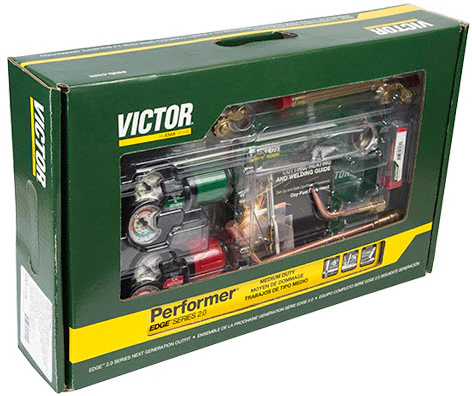
Victor Performer EDGE 2.0 Welding, Heating & Cutting Outfit 0384-2125
- Lifetime Warranty on regulators. 10 Year Warranty on torch handle and cutting attachment
- Cuts up to 6 in. (152.4 mm) with optional tips
- Welds up to 1/4 in. (6.4 mm) with optional nozzles
- Heavy duty construction
- ESS32 EDGE™ 2.0 regulators
- WH100FC torch handle with built-in flashback arrestors and reverse flow check valves
- CA1350 cutting attachment
- Also includes welding nozzle, cutting tip, 12.5 ft. twin hose, striker and soft-sided goggles
$419.00
Everything You Need to Know Before Making This Game-Changing Investment
As I stood in my cluttered garage workshop last weekend, staring at my ancient torch setup with its frayed hoses and temperamental valves, I realized it was finally time for an upgrade. After weeks of research and conversations with fellow metalworking enthusiasts, I took the plunge and invested in the Victor Performer Torch Set. Now, with several projects under my belt using this professional-grade equipment, I’m sharing everything I’ve learned to help you make an informed decision about whether this torch set is right for your needs.
Let me tell you—my only regret is not making the switch sooner. The Victor Performer Torch Set represents the perfect balance between professional quality and accessibility for serious DIYers and professional welders alike. Whether you’re considering your first quality torch set or looking to upgrade from a basic setup, this comprehensive guide will walk you through everything you need to know.
What Exactly Is the Victor Performer Torch Set?
The Victor Performer Torch Set is a professional-grade oxy-fuel cutting and welding system manufactured by Victor Technologies, a company with over 100 years of experience in the welding and cutting industry. When I first unpacked my set, I was immediately struck by the solid construction and premium feel of each component—this is clearly equipment designed to last.
The Performer series sits comfortably in Victor’s product lineup as their mid-tier offering, positioned between their entry-level options and their top-of-the-line professional series. What makes this particular set stand out is its versatility and quality construction while remaining accessible to serious hobbyists and professionals who don’t want to break the bank.
Unlike cheaper alternatives that might work for occasional light tasks but quickly show their limitations, the Performer series is built to handle regular use across various applications. The torch handles are ergonomically designed with brass construction that provides excellent durability while maintaining a comfortable weight for extended use periods.
What’s Included in the Standard Victor Performer Torch Set?
When my package arrived, I eagerly unpacked everything to find a comprehensive set of components ready for immediate use. The standard Victor Performer Torch Set typically includes:
- CA1350 cutting attachment with a 90-degree head design for optimal visibility and control
- WH100C torch handle with built-in check valves for added safety
- Three cutting tips (000, 1, and 3) providing flexibility for different material thicknesses
- One welding nozzle (typically size #2) for standard welding applications
- One heating nozzle for preheating or bending applications
- Oxygen and acetylene regulators designed specifically for the Performer series
- Twin hose set (12.5 ft) with color-coded connections (red for fuel gas, green for oxygen)
- Welding goggles with appropriate shade rating
- Spark lighter for safe torch ignition
- Tip cleaner set for maintaining optimal performance
- Comprehensive instruction manual and quick setup guide
- Heavy-duty carrying case for storage and transport
I was particularly impressed with the inclusion of multiple cutting tips straight out of the box. This allowed me to tackle various projects immediately without needing to purchase additional accessories. The integrated check valves in the handle were also a welcome safety feature that prevented potentially dangerous gas backflow—something my old setup lacked entirely.
What Can You Use the Victor Performer Torch Set For?
Since getting my set, I’ve put it through its paces on numerous projects, and its versatility continues to impress me. The Victor Performer Torch Set is designed for a wide range of applications, including:
Cutting Applications
The cutting attachment and variety of tips make quick work of cutting through various metals. I’ve used it successfully on:
- Steel plates up to 6 inches thick (with the appropriate tip)
- Scrap metal processing for recycling or repurposing
- Precision cuts for fabrication projects
- Demolition work requiring steel beam cutting
- Automotive repair and restoration work
The clean, precise cuts have significantly improved the quality of my fabrication projects. What used to take me multiple attempts with my old equipment now comes out right the first time.
Welding Applications
With the welding nozzle attached, the Performer torch becomes a versatile welding tool. I’ve used it for:
- Joining steel components for furniture projects
- Repair work on farm equipment
- Creating decorative metal art
- Automotive body repairs
- Pipe connections and plumbing repairs
The heat control is remarkably precise, allowing for clean welds even on thinner materials where overheating can be problematic.
Heating Applications
The heating nozzle opens up additional possibilities:
- Bending metal pipes and rods
- Heat treating metal components
- Loosening seized bolts and fittings
- Preheating materials before welding
- Removing paint or coatings from metal surfaces
I recently used the heating nozzle to bend some 1/2-inch steel rod into custom brackets for a shelving project—something that would have been nearly impossible with my previous equipment.
HVAC Applications
The Performer set is particularly well-suited for HVAC professionals. I helped a friend with his air conditioning installation, and we used it for:
- Brazing copper tubing connections
- Silver soldering on refrigeration lines
- Heating components for expansion fitting
- Thawing frozen pipes in emergency situations
The precision control made delicate brazing work on copper lines much more manageable than I expected.
How Does the Victor Performer Torch Set Work?
Understanding the operating principles has helped me get better results and maintain safer working conditions. The Victor Performer Torch Set operates on the oxy-fuel principle, where oxygen and a fuel gas (typically acetylene) are mixed and ignited to produce a high-temperature flame.
The system works through a carefully engineered series of components:
- Gas Supply: The setup begins with separate tanks for oxygen and acetylene.
- Regulators: These critical components reduce the high pressure in the tanks (which can be upwards of 2000 PSI for oxygen) down to working pressures (typically 5-40 PSI depending on the application). The Performer regulators feature dual gauges—one showing tank pressure and one showing working pressure—allowing for precise adjustment and monitoring.
- Hoses: The color-coded hoses deliver the gases from the regulators to the torch handle. The green hose carries oxygen, while the red hose carries the fuel gas. The twin-hose design keeps the gases separate until they reach the torch.
- Torch Handle: This is where the magic happens. The handle features separate control valves for each gas, allowing precise adjustment of the flame characteristics. The built-in check valves prevent dangerous gas backflow, a safety feature I’ve come to appreciate.
- Attachments: Whether using the cutting attachment, welding nozzle, or heating nozzle, each is designed to create the optimal gas mixture and flame pattern for specific applications.
For cutting operations, the process is particularly interesting. The torch first preheats the metal with the outer flame until it reaches a cherry-red state. Then, pressing the cutting lever releases a stream of pure oxygen through the center of the tip, which reacts with the heated metal in a process called “oxidation.” This reaction actually burns through the metal, creating a precise cut.
What impressed me most about the Performer set was how responsive the controls were. Adjusting the flame from a neutral to oxidizing or carburizing state requires just a slight turn of the valves, giving me much more control than I had with my previous equipment.
Where Can I Purchase a Victor Performer Torch Set and What Should I Expect to Pay?
When I was shopping for my set, I found several reliable sources for purchasing the Victor Performer Torch Set:
Welding Supply Stores
Local welding supply stores often carry Victor products and offer the advantage of knowledgeable staff who can provide personalized recommendations. I visited two in my area and found they typically had display models you could examine before purchasing—which helped me appreciate the build quality firsthand.
Industrial Supply Retailers
Chains like Northern Tool, Tractor Supply Co., and Harbor Freight sometimes carry Victor equipment, though selection may vary by location. These can be convenient options if you have one nearby.
Online Retailers
Amazon, eBay, and specialized welding equipment websites like Cyberweld and Weldfabulous offer the Victor Performer set, often with competitive pricing and shipping options. I ultimately purchased mine from a specialized online welding retailer during a seasonal sale.
Direct from Manufacturer
Victor’s official website provides information on authorized dealers, though they typically don’t sell directly to consumers.
Price Range
The Victor Performer Torch Set is a mid-range investment in quality equipment. Based on my research and recent market trends, you can expect to pay between $500-$800 for a complete set with regulators and all standard accessories included.
While this may seem expensive compared to bargain-basement options priced under $200, the quality difference is immediately apparent. My previous inexpensive torch set needed replacement parts after just six months of weekend use. By contrast, many professionals report using their Victor equipment for decades with proper maintenance.
If budget is a concern, I noticed that prices often drop during major sales events like Black Friday or end-of-quarter clearances. Some retailers also offer certified refurbished sets at a 15-20% discount from new pricing.
Cutting and Welding Capabilities: What Can the Performer Handle?
One of the most common questions I had before purchasing was whether the Performer series could handle both cutting and welding effectively, or if it was primarily designed for one function. After extensive use, I can confidently say it excels at both.
Cutting Thickness Capabilities
The cutting capacity of the Victor Performer is impressive, especially considering its price point:
- With a #00 tip: Clean cuts through 1/8″ to 3/8″ steel
- With a #0 tip: Clean cuts through 3/8″ to 3/4″ steel
- With a #1 tip: Clean cuts through 3/4″ to 1-1/2″ steel
- With a #2 tip: Clean cuts through 1-1/2″ to 3″ steel
- With a #3 tip: Clean cuts through 3″ to 6″ steel
- With larger specialized tips: Capability to cut even thicker materials
I personally tested the #1 tip on 1″ steel plate and achieved a remarkably clean cut with minimal slag. For most DIY and light industrial applications, the included tips will handle virtually any cutting task you might encounter.
Welding Capabilities
The welding performance is equally impressive:
- With a #1 welding nozzle: Suitable for thin materials 1/32″ to 1/16″
- With a #2 welding nozzle (typically included): Perfect for 1/16″ to 1/8″ material
- With a #3 welding nozzle: Ideal for 1/8″ to 3/16″ material
- With a #4 welding nozzle: Handles 3/16″ to 3/8″ material
- With a #5 welding nozzle: Capable of welding 3/8″ to 1/2″ steel
I primarily work with 1/8″ and 3/16″ steel for my projects, and the standard #2 nozzle has performed flawlessly. The heat control is precise enough that I’ve even managed some delicate welding on 1/16″ material without burn-through—something that always frustrated me with my previous equipment.
Compatible Gases: What Fuels Your Victor Performer?
The Victor Performer Torch Set is designed primarily for use with oxygen and acetylene, which creates the hottest oxy-fuel flame (up to 6,300°F) and is considered the standard for cutting and welding operations. However, one of the advantages of the Victor system is its flexibility with alternative fuel gases.
With the appropriate setup modifications (primarily different regulators and sometimes different tips), the Performer torch can also work with:
- Propane: Less expensive than acetylene and more readily available, propane produces a flame around 5,000°F. I’ve used propane for heating applications and cutting thinner materials, though it’s not ideal for welding.
- MAPP Gas/Propylene: Offering a hotter flame than propane (around 5,300°F) but cooler than acetylene, these alternatives provide a good balance for general cutting and some welding applications. I keep a MAPP gas setup as a backup for when acetylene isn’t available.
- Natural Gas: In some workshop settings with natural gas lines, this can be an economical choice for heating applications, though it’s not recommended for precision cutting or welding.
When I first set up my system, I consulted with my local welding supply store about the best gas choice for my specific applications. They recommended sticking with the traditional oxygen-acetylene combination for the versatility it offers, which has proven to be excellent advice.
It’s worth noting that changing between gas types requires proper equipment changes and adjustments—this isn’t something you can do by simply switching tanks. Always consult the manual or a professional before attempting to use alternative gases.
Setting Up Your Victor Performer Torch Set: A Step-by-Step Guide
When my set arrived, I found the setup process straightforward but nuanced. Here’s the process I followed, which might help you avoid some of the minor mistakes I made:
Step 1: Safety First
Before beginning assembly, I ensured my work area was:
- Well-ventilated with no flammable materials nearby
- Equipped with a functional fire extinguisher rated for fuel fires
- Clean and organized to prevent tripping hazards
- Far from any electrical equipment that could create sparks
Step 2: Inspect All Components
I carefully unpacked everything and inspected for:
- Any shipping damage to regulators or gauges
- Loose connections or fittings
- Missing O-rings or seals
- Damage to hoses or torch components
Step 3: Secure Gas Cylinders
I secured both my oxygen and acetylene cylinders in proper stands to prevent tipping. The acetylene cylinder must remain upright for at least 30 minutes before use to stabilize the gas.
Step 4: Connect Regulators
This step requires careful attention:
- I “cracked” each cylinder valve briefly (opening slightly then closing) to blow out any dust or debris from the valve opening
- For the oxygen regulator (green), I connected it using the right-hand thread fitting
- For the acetylene regulator (red), I used the left-hand thread fitting (indicated by notches on the fitting)
- I tightened both connections with a proper wrench, being careful not to over-tighten
Step 5: Connect Hoses to Regulators
I attached the green oxygen hose to the oxygen regulator and the red acetylene hose to the acetylene regulator, using the appropriate wrenches to ensure gas-tight connections.
Step 6: Connect Hoses to Torch Handle
I connected the hoses to the corresponding fittings on the torch handle, again being careful not to cross-thread or over-tighten the connections.
Step 7: Attach Desired Accessory
Depending on my first task, I attached either the cutting attachment or a welding nozzle to the handle, making sure the connection was secure but not forced.
Step 8: Pressure Testing
Before lighting the torch, I performed a pressure test:
- With all torch valves closed, I slowly opened the cylinder valves
- I adjusted the regulators to appropriate working pressures (usually 5-10 PSI for acetylene and 20-40 PSI for oxygen, depending on the tip size)
- I closed the cylinder valves and observed the pressure gauges for 5 minutes to check for any drops, which would indicate leaks
- Once satisfied that the system was leak-free, I proceeded to the lighting stage
Step 9: Purging and Lighting
- I opened the acetylene valve on the torch handle about 1/8 turn
- Using the spark lighter (never matches or a conventional lighter), I ignited the acetylene
- I adjusted the acetylene valve until the flame stopped smoking and became bright
- I slowly opened the oxygen valve until I achieved a neutral flame (bright blue inner cone with no excess acetylene)
The entire setup process took me about 30 minutes the first time, including the pressure testing. Now that I’m familiar with the equipment, I can have it ready to use in under 10 minutes.
Essential Safety Precautions When Using a Victor Performer Torch Set
Safety isn’t optional when working with equipment capable of producing flames over 6,000°F. I’ve developed a safety routine that I follow religiously:
Personal Protective Equipment (PPE)
- Eye Protection: I always wear welding goggles with the appropriate shade (usually #5 for cutting and welding). Regular sunglasses are NOT adequate protection.
- Hand Protection: Heat-resistant leather welding gloves protect against splatter and radiant heat.
- Body Protection: I wear a flame-resistant jacket or apron and avoid synthetic fabrics that can melt.
- Foot Protection: Leather boots with protective tops prevent hot metal from falling into footwear.
- Head Protection: A cap or bandana prevents hair from catching fire, and ear protection is used for louder cutting operations.
Workspace Safety
- Ventilation: I ensure proper airflow to prevent the buildup of gases and fumes.
- Fire Prevention: I removed all flammable materials from my work area and keep a Class D fire extinguisher within reach.
- Floor Protection: A concrete floor with no cracks or combustible materials is ideal. I added welding mats in areas where hot metal might fall.
- Tank Security: Gas cylinders are always chained or secured in proper stands to prevent tipping.
- Backflow Prevention: I verify the check valves are functioning properly before each use.
Operational Safety
- Leak Testing: I regularly check for leaks using soapy water on connections (bubbles indicate leaks).
- Proper Startup and Shutdown: I follow the manufacturer’s sequence for lighting and extinguishing the torch.
- Never Use Oil: I keep all equipment free from oil and grease, which can cause explosive reactions with oxygen.
- Proper Pressure Settings: I adjust regulators according to the manufacturer’s recommendations for each tip size.
- One-Third Rule: I never let acetylene tank pressure drop below 1/3 of its original pressure to prevent acetone carryover.
Emergency Procedures
I’ve familiarized myself with emergency shutdown procedures and keep emergency contact information visible in my workshop. I also make sure family members know the location of cylinder valves in case they need to shut off the gas supply in an emergency.
One close call early in my experience with the Performer set reinforced the importance of these safety measures. While cutting some scrap metal, a small piece of hot slag landed on my pant leg. Because I was wearing proper cotton work pants rather than synthetic materials, it simply burned a small hole rather than melting into my skin. That moment was a powerful reminder that proper safety equipment isn’t optional—it’s essential.
Compatible Tips and Accessories to Expand Your Capabilities
One of the aspects I’ve come to appreciate most about the Victor Performer system is its expandability. The basic set provides excellent functionality, but adding specialized tips and accessories has allowed me to tackle an even wider range of projects.
Additional Cutting Tips
Beyond the standard tips included in the set, I’ve added:
- Victor 1-101 Series Tips: These precision cutting tips offer exceptional control for detailed work. I use the 1-101-1 tip for intricate cuts on 1/8″ steel plate when building custom brackets.
- Victor 3-101 Series Tips: These heavy-duty tips are designed for cutting thicker materials. I invested in a 3-101-3 tip for cutting through some 4″ steel beams during a recent renovation project.
- Special Angled Tips: For hard-to-reach cuts, these tips provide angles from 75° to 180°, making it possible to cut in confined spaces.
Welding Nozzles
I’ve expanded my welding capabilities with:
- Multiple Nozzle Sizes: I added #1, #3, and #4 nozzles to complement the included #2, giving me the ability to work effectively on materials from 1/32″ to 3/8″ thick.
- Multi-Flame Rosebud Tip: This accessory creates a broader heating pattern, which I’ve found invaluable for bending operations and heat-treating larger pieces.
Accessories That Made a Difference
Several additional accessories have significantly improved my experience:
- Quick-Connect Fittings: These allow rapid switching between cutting and welding attachments without tools, saving time during complex projects.
- Flash Arrestors: While my set came with built-in check valves, I added external flash arrestors at the regulator connections for an additional layer of safety.
- Premium Tip Cleaners: The included cleaners work well, but I invested in a precision set that helps maintain optimal gas flow and flame characteristics.
- Extended Hose Set: I upgraded to a 25-foot hose set for greater mobility around larger projects in my workshop.
- Magnetic Torch Stand: This simple accessory holds the torch securely when not in use, preventing table burns and keeping the torch within easy reach.
- Digital Pressure Gauges: Though not necessary, these provide more precise pressure readings for specialized applications.
Most of these accessories were available from the same retailers that sell the Victor Performer set, though some specialized items required ordering from dedicated welding supply stores. The investment in these additional tools has expanded the capabilities of my basic set, allowing me to take on increasingly complex projects with confidence.
Maintenance and Cleaning: Keeping Your Performer Set in Prime Condition
Proper maintenance has been key to keeping my Victor Performer set performing like new. I’ve developed a routine that takes only a few minutes but has prevented common issues that could affect performance or safety.
Regular Maintenance Tasks
After each use, I:
- Inspect Hoses: I check for cracks, burns, or soft spots that might indicate deterioration.
- Clean Tips: Using the appropriate size tip cleaner, I gently remove any carbon buildup from the orifices. I’m careful not to use drill bits or other metal tools that could enlarge or damage the precision openings.
- Check O-rings and Seals: I visually inspect all connection points for wear or damage to the seals.
- Verify Valve Operation: I ensure all valves turn smoothly without sticking or excessive resistance.
- Test Check Valves: Periodically, I test the built-in check valves by briefly allowing a small amount of gas pressure into the handle with the cylinder valve closed to ensure they’re preventing backflow.
Monthly Maintenance
Once a month, I perform a more thorough maintenance routine:
- Leak Test: Using a solution of soapy water in a spray bottle, I check all connections for bubbles that would indicate gas leaks.
- Regulator Inspection: I “bleed” the regulators by turning the adjustment screws counterclockwise until fully released, which helps prevent diaphragm issues.
- Thread Cleaning: I clean the threads on all connections with a soft brass brush to remove any debris or corrosion.
- Thorough Tip Cleaning: I soak the tips in a cleaning solution specifically designed for torch tips, then clean with the appropriate tip cleaners.
- Gauge Check: I verify that gauge needles return to zero when pressure is released, indicating they’re still calibrated correctly.
Long-Term Storage
If I know I won’t be using the equipment for more than a month, I take additional steps:
- Complete System Shutdown: I close all cylinder valves, release pressure from the lines, and back off regulator adjustment screws.
- Remove Regulators: For extended storage, I disconnect the regulators from the cylinders and install safety caps on the cylinders.
- Clean All Components: I thoroughly clean all parts to remove any residue or corrosion.
- Proper Storage: I store the equipment in its case in a clean, dry location away from extreme temperatures, chemicals, and moisture.
This maintenance routine has kept my set functioning flawlessly for over two years now. The only replacement parts I’ve needed were O-rings for one connection, which is normal wear and tear for equipment used regularly.
Warranty Information and Customer Support Experience
When investing in professional equipment, warranty coverage and support options are important considerations. Victor’s warranty policy for the Performer series includes:
- Three-Year Limited Warranty: Covers defects in materials and workmanship for most components
- One-Year Coverage: For consumable parts and components subject to normal wear
- Exclusions: Damage from improper use, lack of maintenance, or unauthorized modifications
I had one occasion to contact Victor’s customer support when I was uncertain about a regulator reading. Their response was prompt and helpful—I received a detailed email within 24 hours explaining what I was seeing and confirming that the equipment was functioning normally.
The warranty registration process was straightforward through Victor’s website, requiring only the serial numbers from the main components and proof of purchase. I’d recommend completing this registration immediately after purchase to ensure full warranty coverage.
Based on discussions in online welding forums, Victor has a reputation for honoring their warranty commitments without excessive hassle. Many users report that when legitimate issues arise, the company typically repairs or replaces components quickly.
How Does the Victor Performer Compare to Other Torch Sets?
Before settling on the Victor Performer, I researched several competing options. Here’s how they compared in my analysis:
Comparison with Budget Options
Harris Ironworker 510 Set
- Pros: Lower initial cost (approximately $300-400), decent quality for occasional use
- Cons: Less durable construction, fewer included accessories, less precise flame control
- Verdict: A viable option for very occasional users, but the Victor offers significantly better durability and performance for those who will use it regularly
Generic Import Sets
- Pros: Very low initial cost ($150-250), adequate for extremely light or occasional use
- Cons: Questionable safety features, inconsistent quality control, limited warranty support
- Verdict: The significant safety advantages and reliability of the Victor justified the additional investment for me
Comparison with Similar Mid-Range Options
Smith Little Torch
- Pros: Excellent for precision work, popular for jewelry making and small-scale projects
- Cons: Limited cutting capacity, not as versatile for general workshop use
- Verdict: Better for specialized applications but less suitable for my general fabrication needs
Forney 1705 Medium-Duty Set
- Pros: Slightly lower cost than the Victor, decent performance for medium-duty applications
- Cons: Less robust construction, fewer compatible accessories available
- Verdict: A reasonable alternative, but the Victor’s superior engineering and wider accessory compatibility made it my preference
Comparison with Professional-Grade Options
Victor Professional Series
- Pros: Heavier-duty construction, additional features for intensive professional use
- Cons: Significantly higher cost (30-50% more), overkill for most non-commercial applications
- Verdict: Excellent quality but more specialized than I needed for my workshop use
After this comparative analysis, the Victor Performer emerged as the sweet spot between quality, versatility, and value. The professional-grade performance at a mid-range price point was exactly what I needed for serious DIY and occasional commercial projects.
Replacement Parts Availability: Future-Proofing Your Investment
One of the factors that ultimately convinced me to choose Victor was the excellent availability of replacement parts and consumables. Unlike some import brands where finding compatible parts can be challenging, the Victor ecosystem is well-established with widely available components.
Common Replacement Parts
During my research, I confirmed availability for:
- O-rings and Seals: Available in both individual and kit form for all connections
- Regulators: Both complete units and rebuild kits are readily available
- Cutting Tips: Available individually or in sets from numerous retailers
- Welding Nozzles: Full range of sizes from multiple sources
- Hoses: Both standard and premium replacement options in various lengths
- Valves and Handles: Complete replacement units and internal components
- Gauges: Direct replacements and upgrades available
Where to Find Parts
I’ve found replacement components through:
- Same Retailers: Most places that sell the complete sets also carry replacement parts
- Online Specialists: Websites dedicated to welding supplies often have the most comprehensive selection
- Local Welding Supply Stores: Convenient for immediate needs and often competitive on pricing
- Manufacturer Direct: For unusual or specialized components
The standardization across the Victor line means many parts are interchangeable between different series, further expanding the availability of components. This abundance of replacement parts gives me confidence that my investment will remain serviceable for many years to come, even with regular use.
User Experiences and Testimonials: Real-World Performance
Beyond my personal experience, I’ve collected insights from other Victor Performer users through online forums, local metalworking groups, and conversations with professionals. The consensus opinion aligns with my own findings.
Professional Welder Testimonials
A certified welder in my local metalworking group commented: “I’ve used the Performer set for five years in my mobile repair business. The durability is impressive—I’ve replaced only one regulator and a few O-rings despite daily use in challenging environments.”
Another professional noted: “For the price point, nothing matches the Performer’s balance of quality and affordability. My set has survived three workshop relocations and still performs like new.”
Hobbyist Experiences
Fellow DIY enthusiasts in online forums frequently mention:
- “The precision of the flame control makes delicate work much easier than with my previous budget set.”
- “After upgrading from a hardware store set, the difference in cut quality was immediately noticeable.”
- “The versatility has allowed me to expand my projects without needing to invest in additional specialized equipment.”
Common Points of Consensus
Across both professional and hobbyist users, certain themes consistently emerge:
- Durability: The robust construction withstands workshop abuse better than budget alternatives.
- Flame Control: The responsive valves and well-engineered tips provide exceptional precision.
- Versatility: The ability to handle everything from delicate brazing to heavy cutting with a single system.
- Safety Features: The built-in check valves and quality regulators provide peace of mind.
- Value Proposition: While not the cheapest option upfront, the longevity and performance justify the investment.
The rare negative comments typically center around:
- Initial cost being higher than budget options
- Weight being somewhat heavier than ultralight alternatives
- Learning curve for those transitioning from simpler equipment
These real-world experiences from diverse users reinforced my confidence in the Performer set as a worthwhile investment for anyone serious about metalworking.
Conclusion: Is the Victor Performer Torch Set Right for You?
After extensively using the Victor Performer Torch Set and researching alternatives, I believe it represents an excellent value for serious hobbyists and professionals alike. The combination of professional-grade performance, durability, safety features, and accessible pricing makes the Victor Performer an ideal choice for anyone looking to invest in quality equipment that will serve them reliably for years.
For beginners just exploring metalworking as an occasional hobby, less expensive options might be sufficient. However, for anyone who plans to use their equipment regularly or tackle diverse projects, the additional investment in the Victor Performer set will quickly pay dividends in improved results, greater capabilities, and longer service life.
My personal experience has shown that the precision flame control, durability of components, and versatility across applications have allowed me to take on projects I wouldn’t have attempted with my previous equipment. From delicate jewelry repairs to cutting heavy structural steel, the Performer set has proven equal to every challenge.
If you’re on the fence about making this investment, consider the long-term value rather than just the initial cost. Quality tools expand your capabilities and make the work more enjoyable—and in the case of the Victor Performer Torch Set, they also provide the confidence that comes from using equipment you can trust completely.
Whether you’re building custom furniture, restoring vintage vehicles, creating metal art, or handling professional fabrication tasks, the Victor Performer Torch Set provides the reliable performance and versatility you need to bring your projects to life. In my workshop, it has quickly become one of my most valued and frequently used tools—and I suspect it will earn the same status in yours.